OPINION: Putin’s Potemkin Red Square
Putin’s appearance at Moscow’s anemic Victory Day parade was a painful display of nostalgia stained by denial.
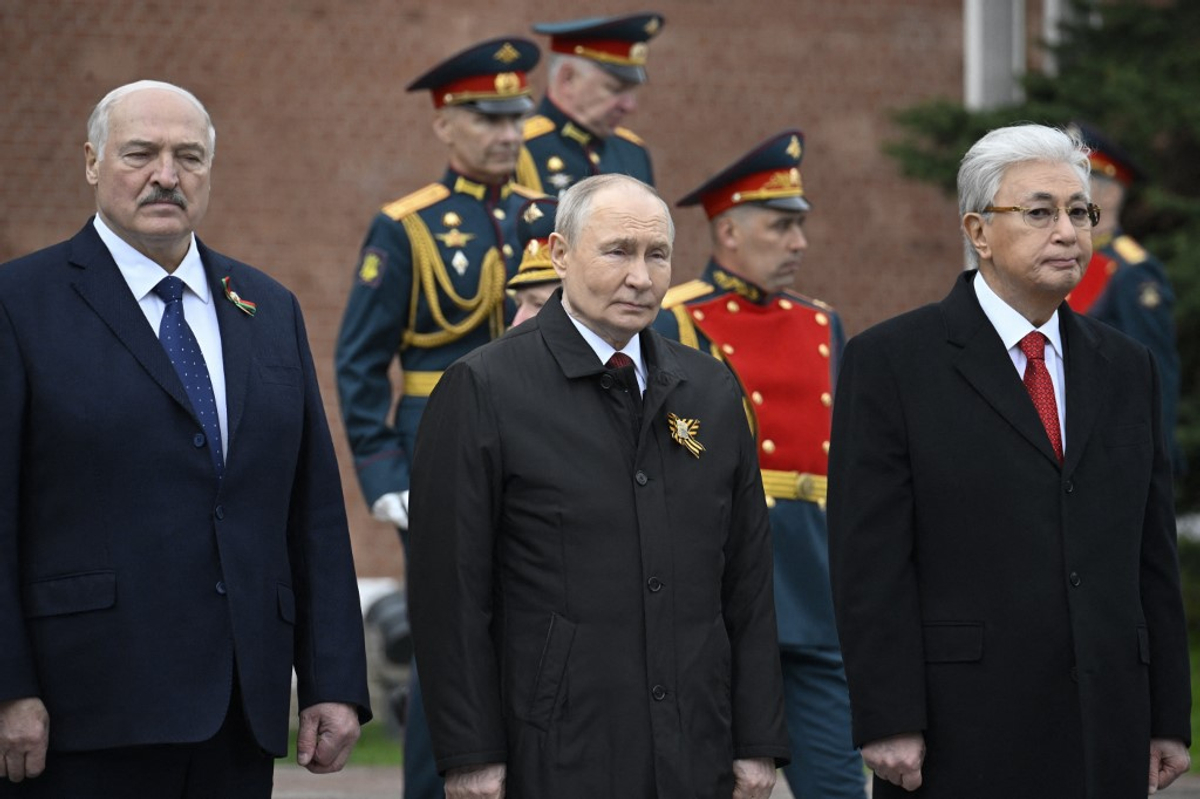
No intelligence service, NATO report, or Western analysis has exposed the true state of Russia today as clearly as this year’s May 9 parade in Moscow. The Kremlin attempted to stage a demonstration of force, but instead produced something grotesque. It resembled late-Soviet political reenactments – ceremonies where everyone knows the system is collapsing, yet protocol is still followed because no one has the courage to stand up and walk away.
That was the main impression from Red Square – not grandeur and power, but the exhaustion of a regime with nothing to show except its past. JOIN US ON TELEGRAM Follow our coverage of the war on the @Kyivpost_official. On May 9, Russia resembled a once-grand aristocratic family still hosting lavish receptions in a house from which the silverware, paintings, and piano had long been sold, while the host persistently assured the guests that everything was under control and that the “temporary difficulties” would soon be over.
Advertisement Vladimir Putin played his role in that spectacle as an aging authoritarian ruler who, through the war in Ukraine, managed to accomplish what the West could not achieve for decades: dismantling with his own hands the myth of Russia as an unstoppable force. That is his historical legacy. Fear of Russia was one of the most important instruments of Russian power.
Ukraine shattered that. Before February 2022, much of the world regarded Russia as a military power around which Europe’s security architecture was built. For years, Western analyses, political assessments, and military plans were based on the assumption that Moscow possessed an army capable of rapid and devastating operations against almost any adversary on the European continent.
Fear of Russia was one of the most important instruments of Russian power. Other Topics of Interest Russia Demands Bosnia OHR Office Closure After Schmidt Departure Russia has urged the immediate closure of the Office of the High Representative in Bosnia following the resignation of German diplomat Christian Schmidt. Moscow argues the body undermines Bosnia’s sovereignty, while the US supports its continued role.
The dispute reflects wider divisions over the country’s post‑war governance and future stability. Ukraine shattered that mechanism more precisely than any sanctions or diplomatic isolation. The world saw Russian columns destroyed near Kyiv.
It saw an army fighting a grueling war for a few kilometers of territory over four years. It saw a state buying drones from Iran, ammunition from North Korea, and electronic components through Chinese intermediaries, all while trying to play the role of a geopolitical power in Europe. Advertisement That is why this year’s parade felt so uncomfortable for the Kremlin.
Behind all the staging, it became impossible to hide the gap between propaganda and reality. The best symbol of this was a single T-34. The Kremlin wanted that tank to represent the continuity of historic victory and Russian grandeur.
In reality, it symbolized a state that no longer has enough modern equipment to organize its own propaganda spectacle without relying on museum exhibits. A war intended to showcase Russia’s renewed power has instead led Moscow to drive a World War II tank across Red Square, while modern technology is destroyed in Ukrainian fields.
This is not a demonstration of power; it is an attempt to mask strategic exhaustion with historical symbolism. Putin moved through Red Square like a man who no longer stands at a helm of the state the world fears, but instead leads an exhausted system struggling to survive its own lies. The view at the podium spoke almost as eloquently as the military parade itself.
Alexander Lukashenko, who long ago stopped leading his country and accepted the role of the Kremlin’s political inventory – a figure brought out when needed so Putin can show he still has someone who comes to him willingly. Robert Fico appeared in Moscow not as a statesman changing European politics, but as a political smuggler of cheap defiance – loud enough to seem “sovereign” at home, but too insignificant to be more than a useful extra in another Putin show at the Kremlin.
Advertisement Thongloun Sisoulith, president of Laos, is a geopolitical figure from Southeast Asia whose presence primarily served as visual evidence that Russia is “not alone. ” His arrival on Red Square carried about as much geopolitical significance as an amateur theater troupe at the Oscars. Sultan Ibrahim of Malaysia was likely the only man in the podium who appeared to attend out of diplomatic curiosity – to see firsthand what an empire looks like when it is shrinking faster than a wool sweater washed in near-boiling water.
Leaders Kassym-Jomart Tokayev of Kazakhstan and Shavkat Mirziyoyev of Uzbekistan acted like company managers searching for a new investor while checking whether the old one was still breathing. Milorad Dodik, leader of BiH-Republika Srpska offered perhaps the saddest proof of how much Putin’s political horizon has narrowed.
The man who once wanted to decide the fate of Europe now receives and parades with a politician from an entity of Bosnia and Herzegovina who holds no state office, as if it were a meeting of great international significance. Advertisement And then there were the North Korean extras. For the first time, soldiers marched on Moscow’s asphalt who now practically serve as human currency with which Kim Jong Un pays for Russian oil and grain.
Their presence is perhaps the final proof of how the “second army of the world” has declined – to the point where a nuclear power with imperial ambitions is importing human flesh from the darkest corners of the planet to sustain a war that was supposed to last only a few weeks. That scene perhaps best illustrates where Putin’s Russia stands today.
The former superpower now highlights military cooperation with Kim Jong Un’s regime as proof of international influence. The state that spent decades trying to persuade the world that it offered a civilizational alternative to the West is now militarily dependent on one of the poorest and most isolated dictatorships in the world.
If someone had told Soviet generals during the Cold War that Moscow would one day display North Korean soldiers on Red Square as a symbol of international support, they would have ended up under KGB surveillance for spreading hostile propaganda. Today, this is the political reality of the Russian Federation. Ukraine destroyed the political image of Russia on which the Kremlin based decades of fear, blackmail, and influence over Europe.
Читайте також
- Heavy Fighting During Second Day of Trump’s Russo-Ukrainian Ceasefire
- Armenia’s Pashinyan Skips Russia-Led Summit After Putin Urges EU-or-EAEU Choice
- Russia, Saudi Arabia Launch Visa-Free Travel From May 11
- North Korea Made Billions Arming Russia for the Ukraine War, Report Says
- Russia Ends Brief Lull With 200+ Drone Strike, Zelensky Warns of ‘Mirror Response’
Новини цього розділу
 Українці виступили проти масового завезення іноземних мігрантів, особливо з Азії та Бангладеш
 Сікорський вказав на переломний момент для Путіна у війні проти України
 Меган Маркл може повернутися у серіал «Форс-мажори»
 На Ніжинщині пенсіонерка віддала шахраям 60 тисяч гривень через схему «Ваш родич у біді»
 Збираємо портфель поза США: варіанти для консервативних і ризикових інвестицій
 Російське судно Ursa Major, що затунуло біля Іспанії, могло везти ядерні реактори для КНДР
 ЄС у червні перерахує Україні перший транш кредиту на 90 млрд євро
 «Нова пошта» відкриває логістичні мінісклади у Вінниці та Полтаві
 Інвестори вимагають від Трампа і Сі Цзіньпіна трималися подалі від штучного інтелекту – Reuters
 Пожежа на автодорозі Одеса-Чорноморськ: поліція відкрила кримінальне провадження

Коментарі
Коментарів ще немає. Будьте першим у цій дискусії.