The Territory of Lawlessness
Occupation is not peace. A new Ukrainian report argues that Russian rule in occupied territories is just another battlefield, one where the law and legal institutions have become weaponized.
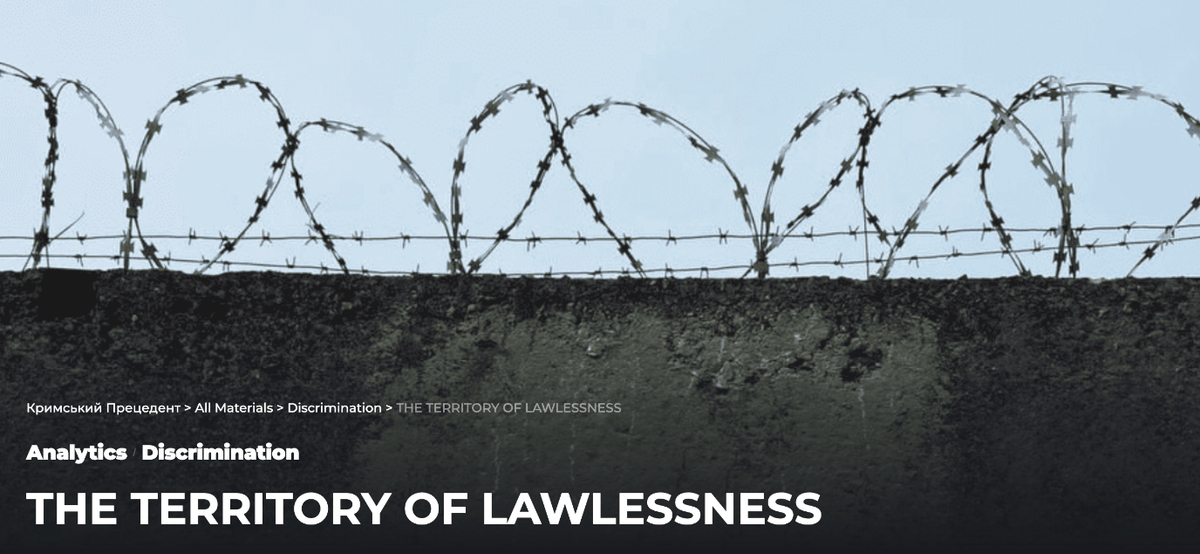
At first the title seemed almost too emphatic, the kind of phrase one fears has been sharpened by advocacy rather than evidence: “The Territory of Lawlessness. ” However, as the press conference in Kyiv unfolded on March 25, the title became diagnostic and not at all rhetorical. The event at Media Center Ukraine was, on its face, a presentation of a new analytical report by the Regional Center for Human Rights (RCHR).
In substance, it was an evidentiary argument about how to understand Russian occupation. Distance has a way of turning occupation into abstraction. From afar, the occupied territories are too often discussed in the antiseptic language of strategy: front lines, frozen conflict, bargaining territory, gray zones, spheres of control.
Such language makes the condition sound static and almost administrative. It flattens lived experience into cartography. Advertisement JOIN US ON TELEGRAM Follow our coverage of the war on the @Kyivpost_official.
The report resists that flattening with unusual force. The temporarily occupied territories of Ukraine, it argues, are not “gray” or “buffer” zones in “disputed” territories, but places where “the law as an instrument of protection has been eradicated, and replacement legislation has become a means of suppression, control, and assimilation.
” Russia’s project, the report says, is not merely to hold land temporarily under military control, but to dismantle Ukraine’s legal order and replace it with a coercive Russian system of its courts, its police, administrative structures, citizenship regime, school system, and its punitive vocabulary. What is intentionally imposed is not chaos but something more insidious: law preserved in a form and hollowed out in purpose.
Other Topics of Interest ‘Ukraine Needs Strong Civilian Firearms Law,’ Zelensky Says as Officials Prepare Bill Volodymyr Zelensky says Ukraine is preparing a new civilian firearms law as officials, military and lawmakers push to regulate weapon ownership during wartime. The inversion of law turned against the people it is meant to protect was the real subject of the presentation.
Kseniia Korniienko, Senior Lawyer at the NGO RCHR Regional Center for Human Rights; Mykyta Petrovets, expert at the NGO Regional Center for Human Rights; Kateryna Rashevska, analyst at the NGO Regional Center for Human Rights, Ph.D.
in International Law; Olena Khomenko, Member of the Ukrainian Parliament, Chair of the PACE Parliamentary Network on the Situation of Children in Ukraine (Photo: Media Center Ukraine) Advertisement Kateryna Rashevska, analyst at the Regional Center for Human Rights and one of the report’s authors, put it in a sentence that clarified almost everything that followed. Russia, she said, is trying to persuade the international community that “occupation is peace.
” But “occupation,” she insisted, “is a separate battlefield. ” It is a remarkable formulation because it restores motion and violence to a condition that outsiders often imagine as static. Occupation, in her telling and in the report’s, is not what remains when active war subsides.
It is war by other means. War not only by shelling and imprisonment, but by documentation, intimidation, school curricula, passport controls, confiscation orders, filtration procedures and the systematic conversion of civilian life into dependency. On that battlefield, Rashevska said, the adversaries are not principally armies facing armies.
They are “Russian siloviki” confronting “Ukrainian civilians, mostly women, the elderly, and children. ” Advertisement That line gave the presentation of the report its shape and a moral center. Rashevska told journalists that between 3 and 5 million Ukrainians in occupied territories are exposed every day to human-rights violations.
Some are the brutalities by now grimly familiar such as torture, arbitrary detention, forced deportation, forced transfer, forced mobilization. Others are quieter and, for that very reason, easier for the outside world to overlook: coerced passportization, cultural assimilation, russification, the militarization of children, political indoctrination through education.
These abuses do not always leave blood visible on the floor, but they alter the conditions under which a people remains itself. “The international community is gradually developing a resistance to these violations,” Rashevska warned, noting that coverage of occupation has thinned as attention shifts elsewhere. One purpose of the report is to fight that numbness before it becomes a habit of forgetting.
Advertisement The report itself is built to resist forgetting. It draws not only on legal analysis and open-source documentation, but on roughly 300 cases the organization handled through UN treaty bodies, the European Court of Human Rights and submissions to the International Criminal Court. What emerged from that accumulation, Rashevska said, was not merely a catalogue of grievances but a discernible pattern of a Russian intentional system, consistent across regions and years, in which occupation does not suspend law but retools it against the people.
Under international humanitarian law, occupation is temporary. It does not transfer sovereignty. The occupying power must preserve the existing legal order as far as possible and protect the civilian population under its control.
Russia, the report argues, has done the opposite in every essential respect by unlawfully extending Russian legislation into occupied territory, imposing Russian citizenship, holding pseudo-referendums, establishing corrupt Russian-controlled courts and law-enforcement bodies, and criminalizing pro-Ukrainian identity through false charges of extremism, terrorism, or “discrediting” the Russian armed forces.
The report’s introduction describes this not as an accumulation of excesses but as “a coordinated policy aimed at eradicating Ukrainian identity, forcibly altering the demographic composition of the population, and ‘legalizing’ annexation in the foreseeable future. ” Advertisement Kseniia Korniienko Senior Lawyer RCHR. (Photo: Media Center Ukraine) Kseniia Korniienko, a senior lawyer with RCHR provided clarity to Russia’s legal fraud.
Occupation, she reminded the room, does not give the occupier sovereignty over the land it controls. Yet Russia has spread “its own legislation and a system of administrative, law-enforcement and judicial bodies” across temporarily occupied Ukrainian territory and now persecutes civilians for failing to comply with Russian laws that, “under every legal norm,” should not apply there at all.
The effect is not merely the violation of rights but the destruction of remedy. Once Russian law is forced into place, nearly every abuse can be restaged as procedure. Torture can be followed by interrogation minutes.
Expropriation can be accompanied by a registry entry. Deportation can be processed through a file. Violence acquires format.
Advertisement Torture chamber in Kherson. (Screenshot from a video by the publication “Mist”) The report is especially good at showing how propaganda, coercion and pseudo-justice form a continuum. One of its most revealing case studies is that of Vladyslav Yesypenko, the Radio Liberty freelance journalist detained in Crimea in 2021.
Russian state media quickly turned him into a public character as a collaborator with Ukrainian intelligence, a man already guilty in the imagination before a courtroom had meaningfully convened. But the report notes a telling discrepancy. The occupation courts that later handled the case did not even rely on the espionage narrative so loudly amplified in propaganda.
The mismatch is revealing. Truth was never the central concern. The media’s role was to saturate the space around Yesypenko with suspicion and guilt; the court’s role was to give punishment an official shape afterward.
The sequence of arrest, narrative, sentence tells one nearly everything one needs to know about the system. The courtroom is not where force is tested against evidence. It is where force acquires paperwork.
Another case follows Hennadiy Kharchenko, Oleksiy Zhernovskyi and Ihor Kim, Ukrainian servicemen prosecuted in occupied Donetsk. In Russian reporting they appear as Azov “militants,” ideological criminals whose convictions ratify the broader Kremlin story that Ukrainian resistance is extremism by another name.
But the report reconstructs a different reality of fabricated charges, torture, broken teeth and ribs, dramatic weight loss, forced confessions, the conversion of Ukrainian military service into criminal identity, and a courtroom used to turn captivity into political theater. A state that invaded another country appoints itself moral judge over those who fought against its invasion.
The obscenity is obvious. The occupation court is the institution built to normalize it. The court does not interrupt abuse.
It arranges it into admissible form. The report’s section on the “White Angels,” the Ukrainian police evacuation teams that rescued civilians from frontline areas near Pokrovsk, shows the same system from a different angle. Russian media portrayed the evacuation teams as child abductors.
The report places that claim against the actual legal framework and the actual facts. Under Ukrainian law, children must be compulsorily evacuated from active combat zones under careful specific humanitarian conditions. These teams had helped move more than 10,000 civilians, including more than 1,000 children, away from direct shelling and likely occupation.
The point is larger than debunking a lie. It is to show how occupation works rhetorically as well as institutionally. Protection is re-described as abuse.
Rescue is recast as kidnapping. The state trying to preserve civilian life is made to appear criminal, while the invading power claims the language of order and guardianship and commits the crimes it attributed to the other. The report’s glossary of Russian distortions is one of its most quietly devastating and revealing sections.
There, occupation reveals itself not just as a system of force but as a system of naming. “Special military operation” means full-scale invasion. “Saving children from hostilities” means deportation and forced transfer.
“Military-patriotic upbringing” means indoctrination and militarization. “Reunification” means annexation. Euphemism is not a side effect of Russian rule here; it is one of its governing instruments.
If the vocabulary can be bent far enough, reality itself becomes contestable. A child can be stolen and described as rescued. A territory can be occupied and described as returned.
A court can persecute and still call itself justice. Still, a haunting moment of the press conference came not from doctrine but from one family story. Rashevska described a family from Zaporizhzhia that had gone to visit a relative in a village shortly before the full-scale invasion.
They expected to stay only a few days. They brought almost nothing. Then, as she put it, “they woke up in occupation.
” Few phrases better capture the obscene arbitrariness of modern war. A short family visit becomes indefinite entrapment. A bag packed for several days becomes all one has for an occupation that may last years.
The courtroom is not where force is tested against evidence. It is where force acquires paperwork.
Читайте також
- Investors Still Eye Ukraine Reconstruction Despite War, PrivatBank CEO Says
- ISW Russian Offensive Campaign Assessment, May 10, 2026
- Росія переслідують журналістів та вербують до армії на окупованих територіях
- ISW Russian Offensive Campaign Assessment, May 8, 2026
- Кремль заборонив іноземним журналістам висвітлювати парад 9 травня в Москві
Новини цього розділу
 Україна та Ізраїль можуть укласти меморандум щодо зерна з окупованих територій
 Клінкерна плитка для фасаду: надійний захист та естетика на десятиліття
 Харківському ексдепутату на додачу до державної зради повідомили ще одну підозру
 Режим Кім Чен Ина "озолотився" на підтримці Росії у війні проти України
 Росіяни планують захопити Донецьк для тиску на Харків
 На Харківщині зірвали будівництво двох підземних шкіл
 Трамп виведе війська, і Конгрес його не зупинить: генерал Годжес розповів, чому система дає збій
 Не тільки Шевченко: які футболісти з України були у фіналі Ліги чемпіонів
 Рука Будди у Гуандуні: як піднятися до гігантської долоні над безоднею
 Стало відомо, жителі яких країн заразилися хантавірусом на круїзному лайнері

Коментарі
Коментарів ще немає. Будьте першим у цій дискусії.